
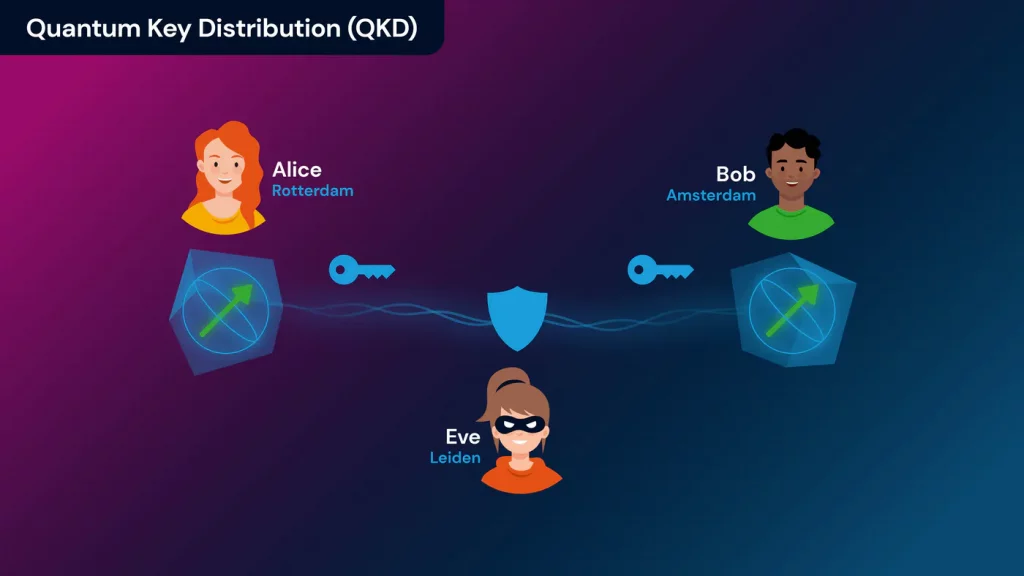
The event I attended on Friday caught my attention for several reasons. Billed as the Quantum Network Explorer (QNE) Launch, it took place in the Hague, the Netherlands, not far from where I live. In a year that has seen so much exciting progress on quantum networks, I was curious to find out what it involved. But I was also drawn by the event’s name, which made it sound a lot like Microsoft’s all-but-defunct web browser, Internet Explorer.
Month:November 2021
Physics World: Physicists create discrete time crystals in a programmable quantum simulator

Time crystals are special quantum systems that exhibit periodicity in time, just as crystalline materials are periodic in space. Since 2012, when they were first proposed theoretically, several groups have built experimental systems that demonstrate key characteristics of time crystals, but these results lacked a method to generally stabilize the time crystalline phase. An international team of researchers has now gone beyond previous experiments by creating a type of time crystal known as a discrete time crystal (DTC) out of a chain of programmable spin quantum bits (qubits). The new system exhibits a phenomenon known as many-body localization that prevents the DTC from heating up and thermalizing and is considered a “smoking gun” that demonstrates its status as a genuine time crystal.
Physics World: Laser-free trapping of heavy molecules opens an alternative route to new physics
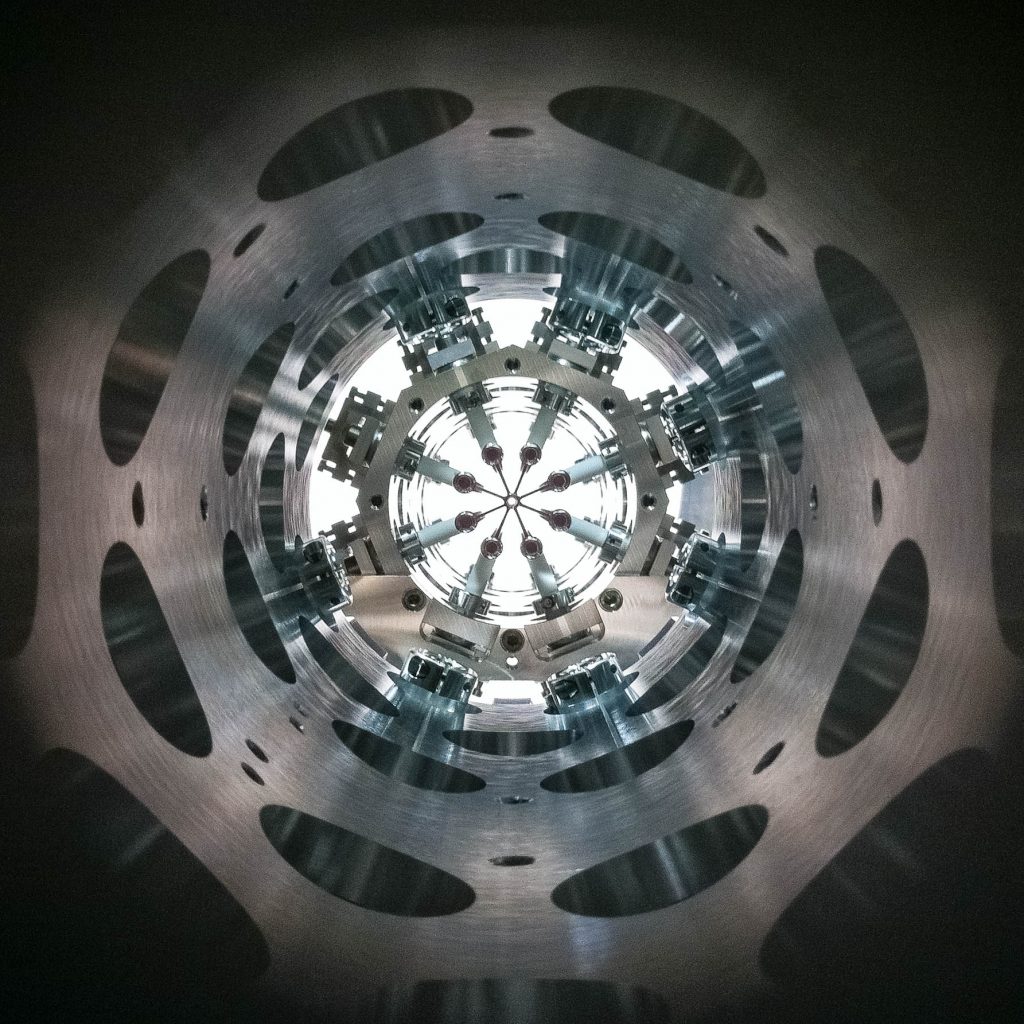
The quest for physics outside the Standard Model often takes place at major accelerator facilities like CERN’s Large Hadron Collider or huge underground detectors for neutrinos, dark matter and other exotic particles. Researchers in the Netherlands have now opened an alternative front in this quest by developing a new laboratory-scale technique for trapping heavy neutral molecules. Such molecules are considered ideal candidates for detecting beyond-the-Standard-Model asymmetries in the electron’s electric dipole moment (eEDM), but previous methods were not capable of confining them. The technique therefore gives physicists a fresh set of tools for finding new physics.